Hamal Ezrahi

Building a Crisis Communication Infrastructure

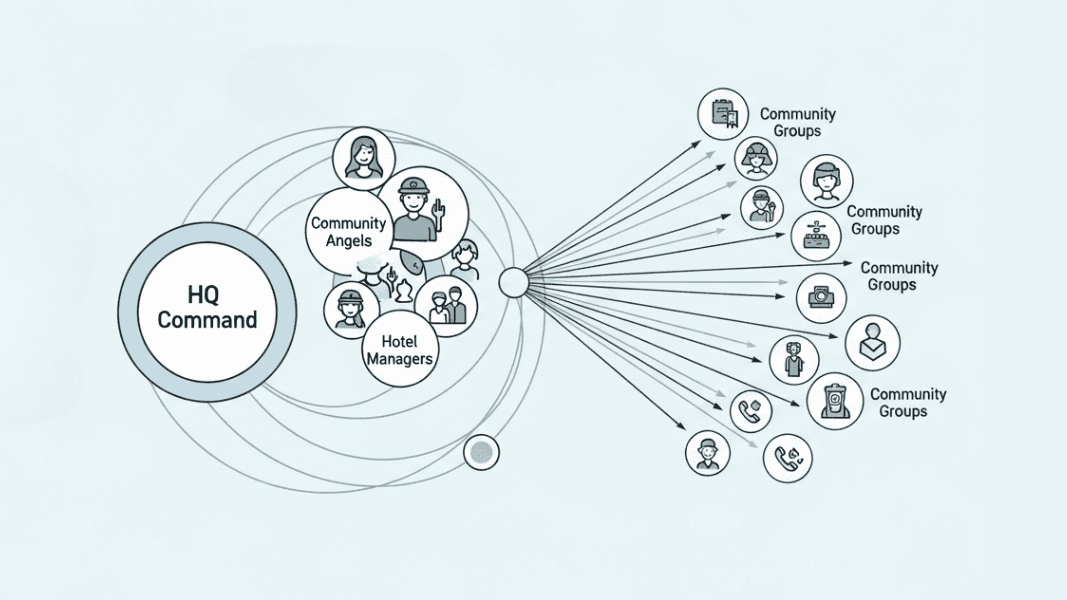
A week after October 7th, I arrived in Eilat, one of the main cities hosting large numbers of evacuees from the south. I came initially to help with small logistics tasks. After speaking with evacuees and community leaders directly, I identified a critical gap: ~40,000 evacuees were being served by the initiative with no reliable, centralized way to find relevant aid, connect with local resources, or receive updates. Information was scattered across WhatsApp groups, and word of mouth but was not accessible by all. I proposed building a communication and connection infrastructure and was given full autonomy to execute it.

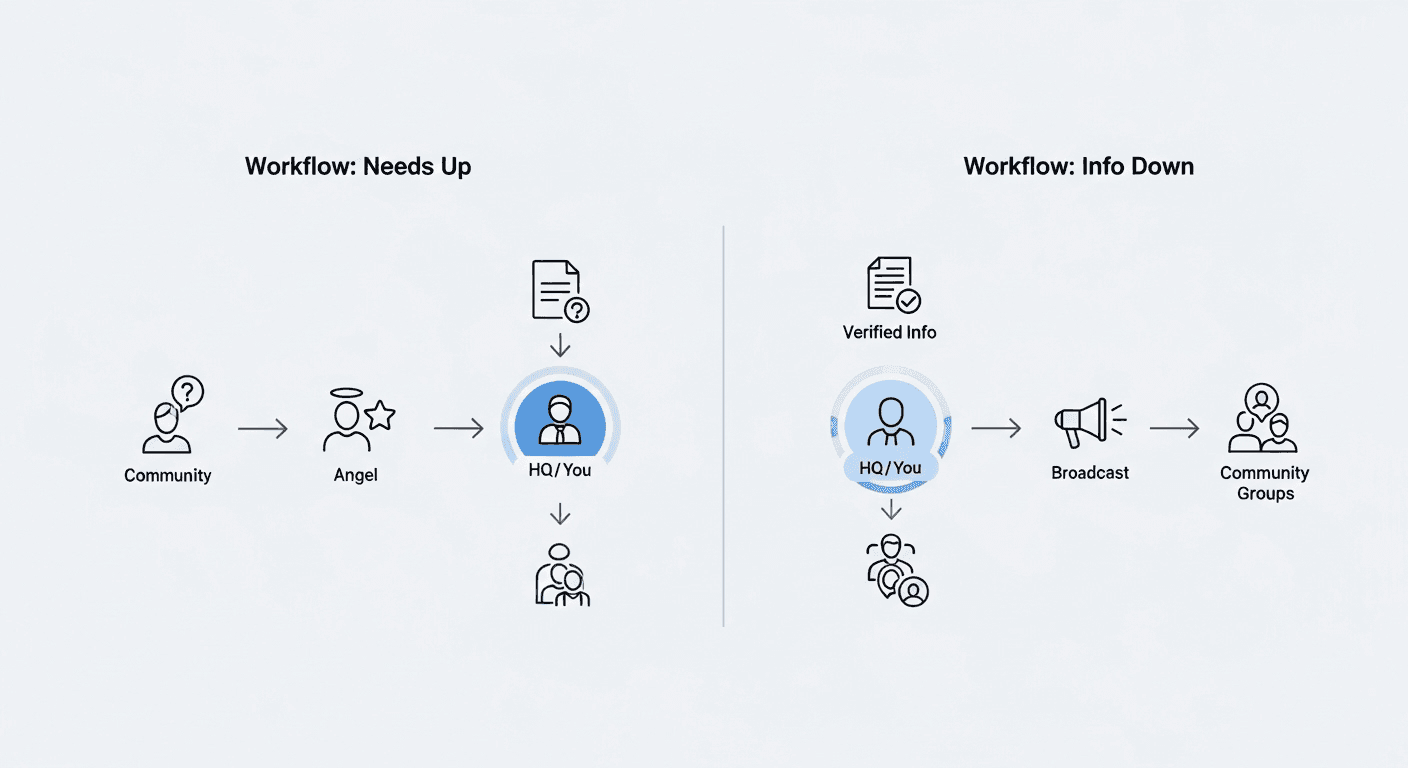
This wasn't a traditional PM role. The product was partly digital, a lightweight web page routing users to bots, WhatsApp contacts, and aid organization websites based on their need, and partly physical. I coordinated volunteers who went in-person to hotels to guide evacuees through using the platform, because many were in a mental state where self-service wasn't realistic.
Role | Self-initiated Project Lead (volunteer)

Platform | Web + WhatsApp/Bot integrations

Team Type | All-volunteer designers, developers, field coordinators

Role | Self-initiated Project Lead (volunteer)

Platform | Web + WhatsApp/Bot integrations

Team Type | All-volunteer

THE CHALLENGE

OUTCOME

  • Evacuees were organized by their original communities but had no shared infrastructure to receive relevant information or request help — each community leader was operating in isolation.

  • The population was in acute psychological distress — "just build a good UX" wasn't sufficient; people needed human guidance to use even a simple tool.

  • No budget, no formal team, no existing codebase — everything had to be built and coordinated from scratch with volunteers.

  • Timeline pressure was real: people needed help now, not in a month.

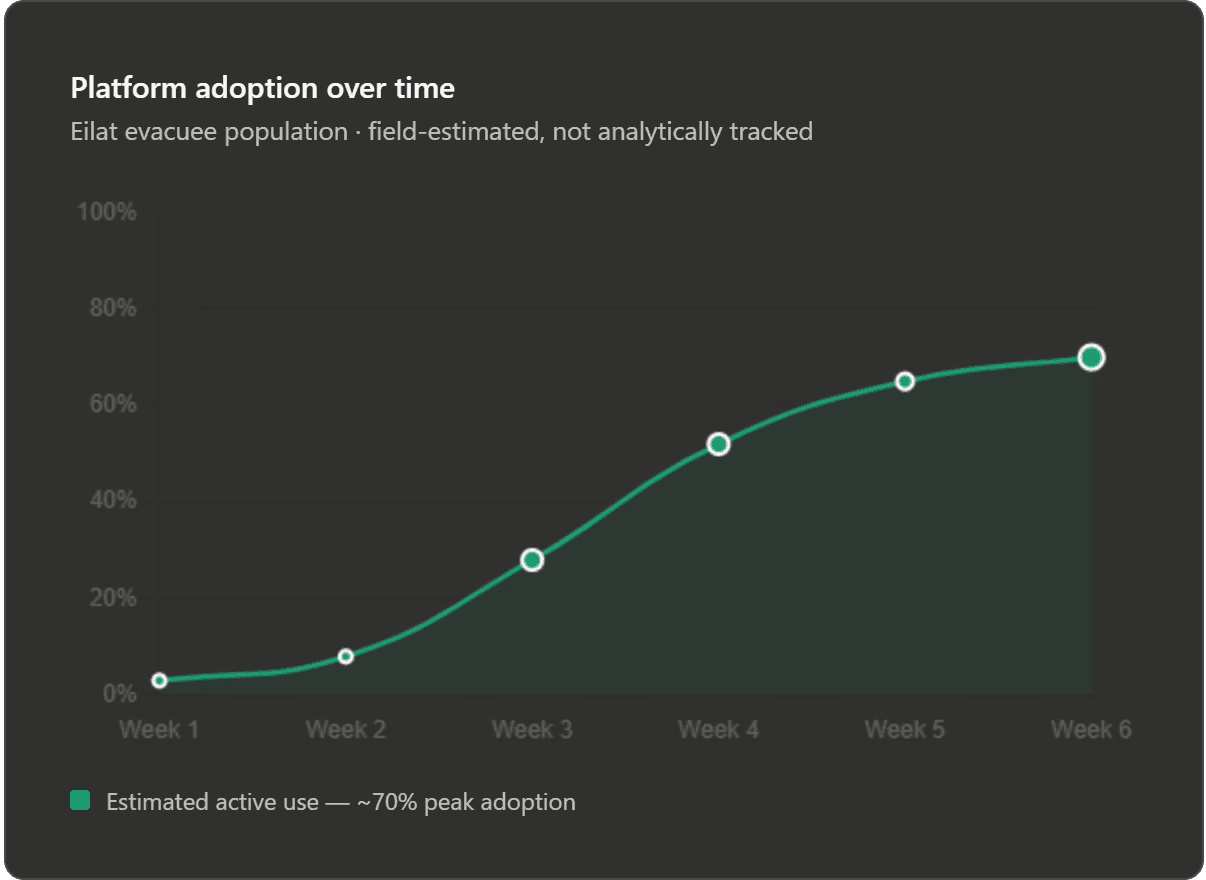
  • ~70% adoption among the target evacuee population - estimated from field observation, not analytics

  • Thousands of evacuees connected to specific aid via the platform - observed through community leader feedback and volunteer reports, exact number unverified

  • Handed off a running operation after one month - documented, transitioned ownership, continued operating after my departure

THE CHALLENGE

  • Evacuees were organized by their original communities but had no shared infrastructure to receive relevant information or request help — each community leader was operating in isolation.

  • The population was in acute psychological distress — "just build a good UX" wasn't sufficient; people needed human guidance to use even a simple tool.

  • No budget, no formal team, no existing codebase — everything had to be built and coordinated from scratch with volunteers.

  • Timeline pressure was real: people needed help now, not in a month.

WHAT I DID

THE CHALLENGE

  • Mapped the actual need before building anything - spoke directly with hotel managers, city welfare departments, and community leaders to understand what information evacuees were asking for and what aid organizations were able to provide.

  • Chose simplicity over sophistication - decided against a custom app or complex system. Built a single web page with structured links routing to existing bots, WhatsApp numbers, and websites based on aid type and organization preference. Fastest path to functional, lowest barrier to use.

  • Solved for mental state, not just usability - recognized that standard adoption assumptions didn't hold. Deployed volunteers physically into hotels to sit with evacuees and walk them through the platform. This was the key adoption unlock, not a UX fix.

  • Used community leaders as both research and distribution channels - worked with them to understand evolving needs and to push platform updates out through existing trust networks.

  • Handed off with a clear transition - after one month, once the platform was stable and running smoothly, I documented and transferred ownership to a designated person so I could move to other initiatives.

  • Evacuees were organized by their original communities but had no shared infrastructure to receive relevant information or request help — each community leader was operating in isolation.

  • The population was in acute psychological distress — "just build a good UX" wasn't sufficient; people needed human guidance to use even a simple tool.

  • No budget, no formal team, no existing codebase — everything had to be built and coordinated from scratch with volunteers.

  • Timeline pressure was real: people needed help now, not in a month.

ADJACENT INITIATIVES

  • Created a free 3-day hotel program for families living near the warzone (not evacuated, but living under active fire) - coordinated with city welfare departments to identify and bring families with financial hardship or children with disabilities.

  • Built a local kitchen network connecting evacuee families with local host families, so parents could cook their own food in a home kitchen instead of relying on hotel meals.

  • Organized rest events for soldiers - coordinated a local chef, venue, and DJ to give combat units a break.
WHAT I DID

  • Mapped the actual need before building anything - spoke directly with hotel managers, city welfare departments, and community leaders to understand what information evacuees were asking for and what aid organizations were able to provide.

  • Chose simplicity over sophistication - decided against a custom app or complex system. Built a single web page with structured links routing to existing bots, WhatsApp numbers, and websites based on aid type and organization preference. Fastest path to functional, lowest barrier to use.

  • Solved for mental state, not just usability - recognized that standard adoption assumptions didn't hold. Deployed volunteers physically into hotels to sit with evacuees and walk them through the platform. This was the key adoption unlock, not a UX fix.

  • Used community leaders as both research and distribution channels - worked with them to understand evolving needs and to push platform updates out through existing trust networks.

  • Handed off with a clear transition - after one month, once the platform was stable and running smoothly, I documented and transferred ownership to a designated person so I could move to other initiatives.

OUTCOME

  • ~70% adoption among the target evacuee population - estimated from field observation, not analytics

  • Thousands of evacuees connected to specific aid via the platform - observed through community leader feedback and volunteer reports, exact number unverified

  • Handed off a running operation after one month - documented, transitioned ownership, continued operating after my departure

OUTCOME

  • ~70% adoption among the target evacuee population - estimated from field observation, not analytics

  • Thousands of evacuees connected to specific aid via the platform - observed through community leader feedback and volunteer reports, exact number unverified

  • Handed off a running operation after one month - documented, transitioned ownership, continued operating after my departure

LEARNING & REFLECTION

  • The product was never just the web page. The real product was the system: digital tool + volunteer guidance + community leader distribution. Treating the LP as "the thing" would have gotten low adoption. Understanding what was actually blocking use — psychological state, not UX — changed the whole strategy.

  • Speed required accepting imperfect tools. A custom-built solution would have been better in theory. Choosing existing infrastructure (WhatsApp, bots, external links) meant launching in days rather than weeks. In a crisis, a good-enough product live now beats a better one live later.

  • Autonomy without a mandate is still earned. I wasn't assigned this project — I had to identify the gap, propose the solution, and build trust with hotel managers and council leaders who had no reason to listen to a volunteer showing up with an idea. That stakeholder work was as important as the product work itself.
CONTACT ME

Made by Tomer Miara | 2026